We use Google Analytics to understand website usage and improve your experience. Analytics cookies are optional and will only be used with your permission.
The Shoreline Storage Tunnel (SST) project is part of Project Clean Lake, a $3 billion, 24-year program that the Northeast Ohio Regional Sewer District (NEORSD) began in 2011 to meet Clean Water Act standards and address water quality issues. The SST is the fifth of seven new large-diameter tunnels, along with other projects that NEORSD will use toward Project Clean Lake’s overall goal to reduce the 4.5 billion gallons (17 billion liters) of wet weather combined sewer overflows (CSOs) released into Lake Erie and its tributaries in the Greater Cleveland area.
The SST includes nearly 2.7 miles (4.3 km) of 23-foot-diameter (7 m) soft ground tunnel 100 to 120 feet (30–37 m) below ground that will capture and store overflows from CSO outfalls along the Lake Erie shoreline. The SST will then convey these overflows to other NEORSD tunnels and sewers, which will transport the flows to the Easterly Wastewater Treatment Plant for treatment before release into the environment.
Construction of the SST was awarded to the McNally/Kiewit SST (MK) joint venture. NEORSD issued a Notice to Proceed in July 2021, with substantial completion and final completion now set for June 2026 and October 2026, respectively. After providing overall design management, including tunnel and shaft design and geotechnical engineering, Delve Underground transitioned from the design phase to the construction phase. During tunnel excavation, three Delve Underground employees were on site supporting NEORSD’s construction management personnel with construction inspection, tunnel boring machine (TBM) performance monitoring, and coordination of design services (e.g., shop drawing review, RFIs, change order evaluation, and change management).
The tunnel was excavated with a 26-foot-diameter (8 m) Herrenknecht earth pressure balance tunnel boring machine (EPM TBM) with a face pressure near 3.5 bar. MK designed a 6-foot-long (1.8 m) tunnel precast segment final lining. The TBM excavation was completed in May 2024.
Since the completion of the SST, several near-surface structures, shafts, and consolidation sewers have been completed.
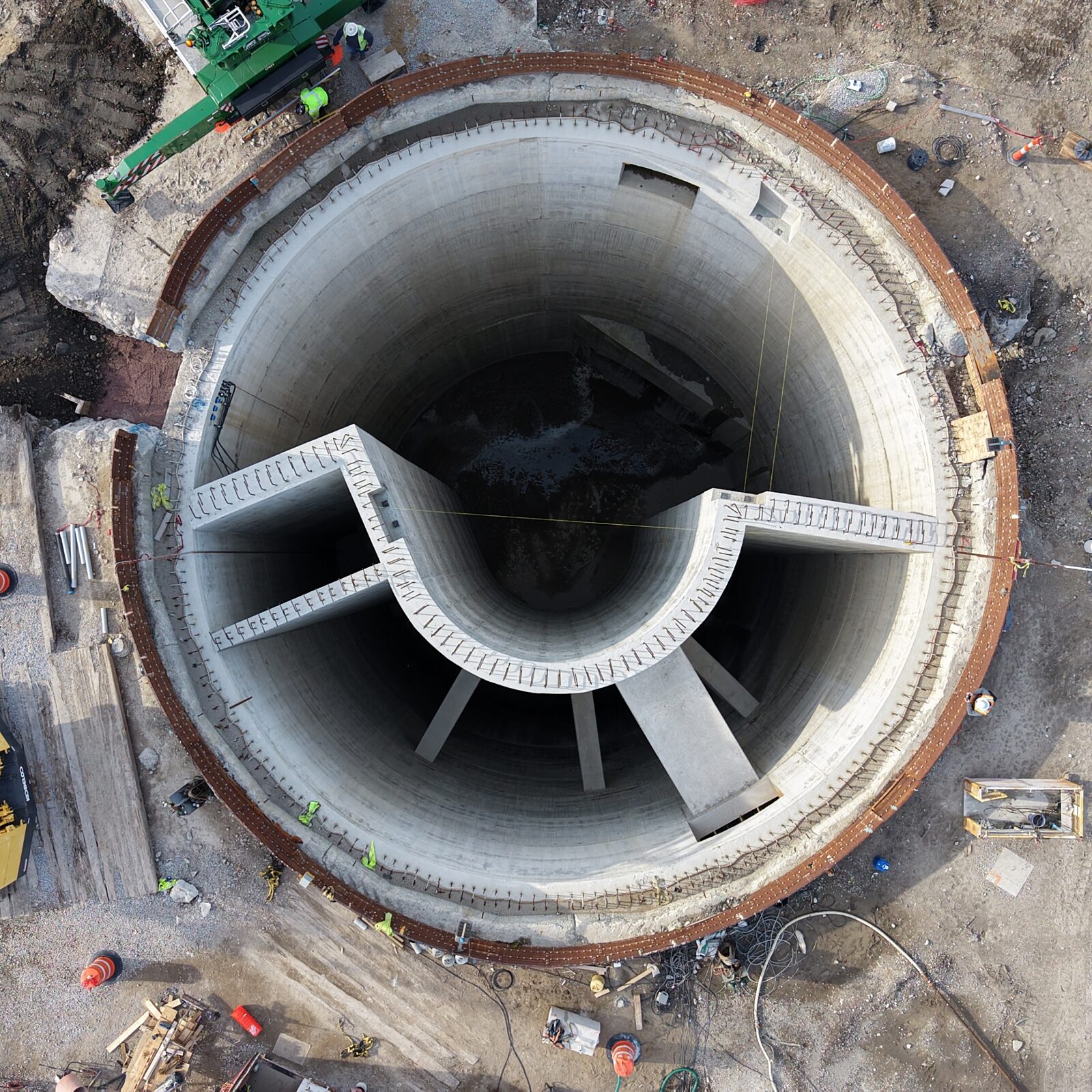
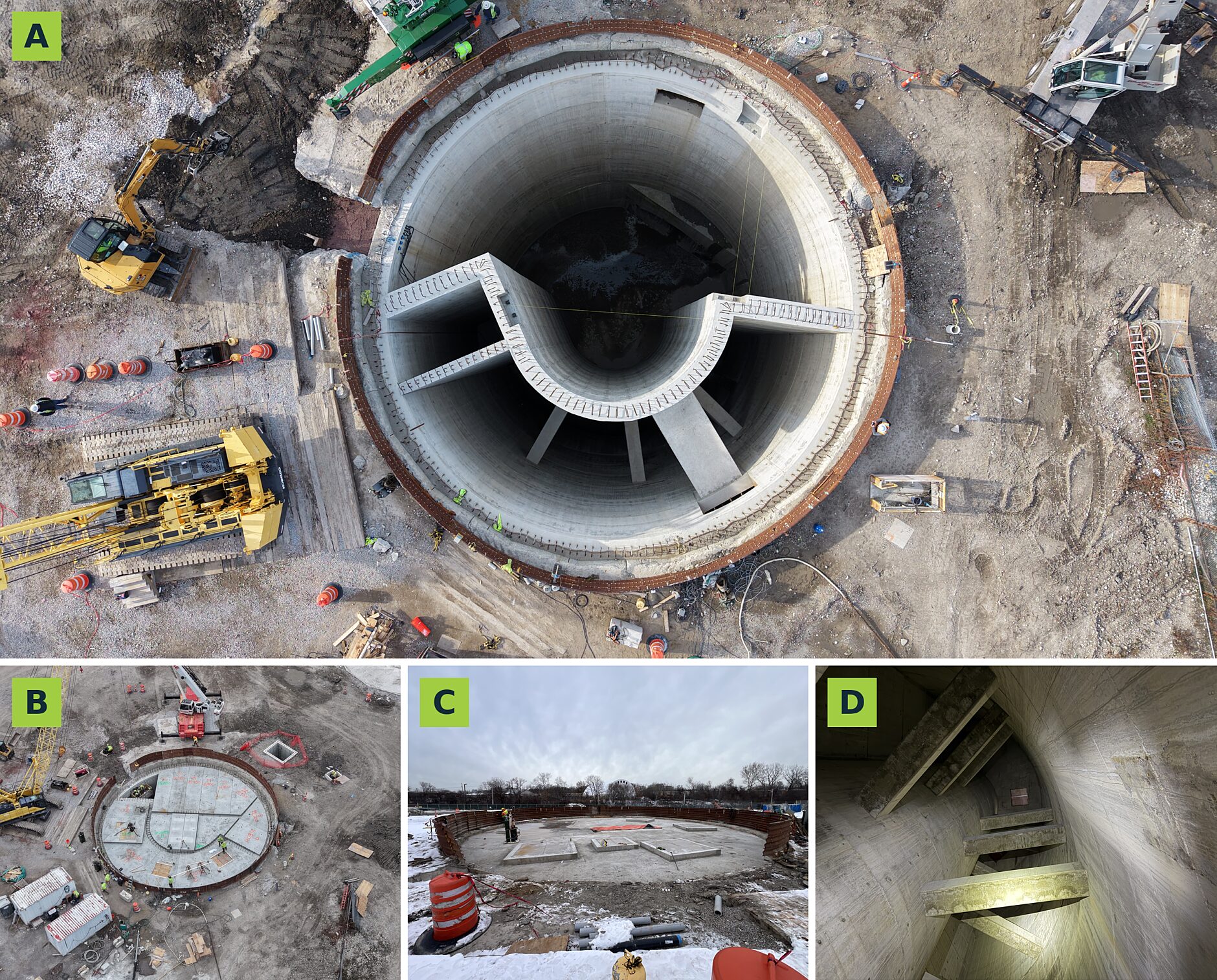
(A) Completed internals; (B) Precast roof plank installation; (C) CIP roof and access hatches; (D) Post construction inspection
SST-1 Shaft
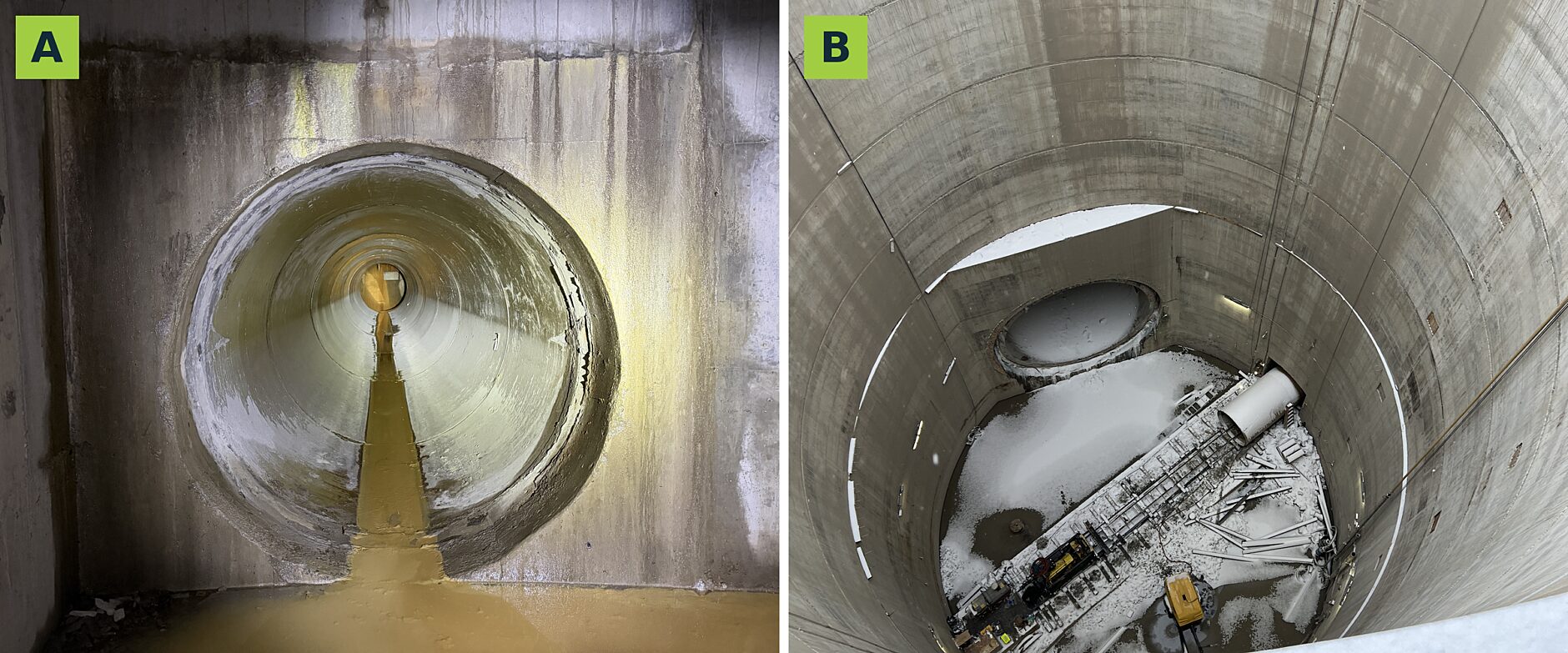
This structure is a 61-foot (18.6 m) inside diameter (ID) shaft approximately 122 feet (37.2 m) deep. This shaft was designated as the launch shaft for the TBM. The permanent internal shaft structures included a 2.5-foot (0.8 m) curved dividing wall, 3-foot (1 m) gate and end wall, 1.5-foot (0.5 m) baffle and stilling basin wall, 5 baffle slabs, 11 baffle blocks, 12 struts, collar, two precast beams, two hydraulic gates, and the emergency overflow box culvert. These internal structures, along with the precast roof planks, removable roof planks, and cast-in-place (CIP) roof slab, were completed in December 2025. The SST-1 Shaft post-construction inspection was performed in March 2026.
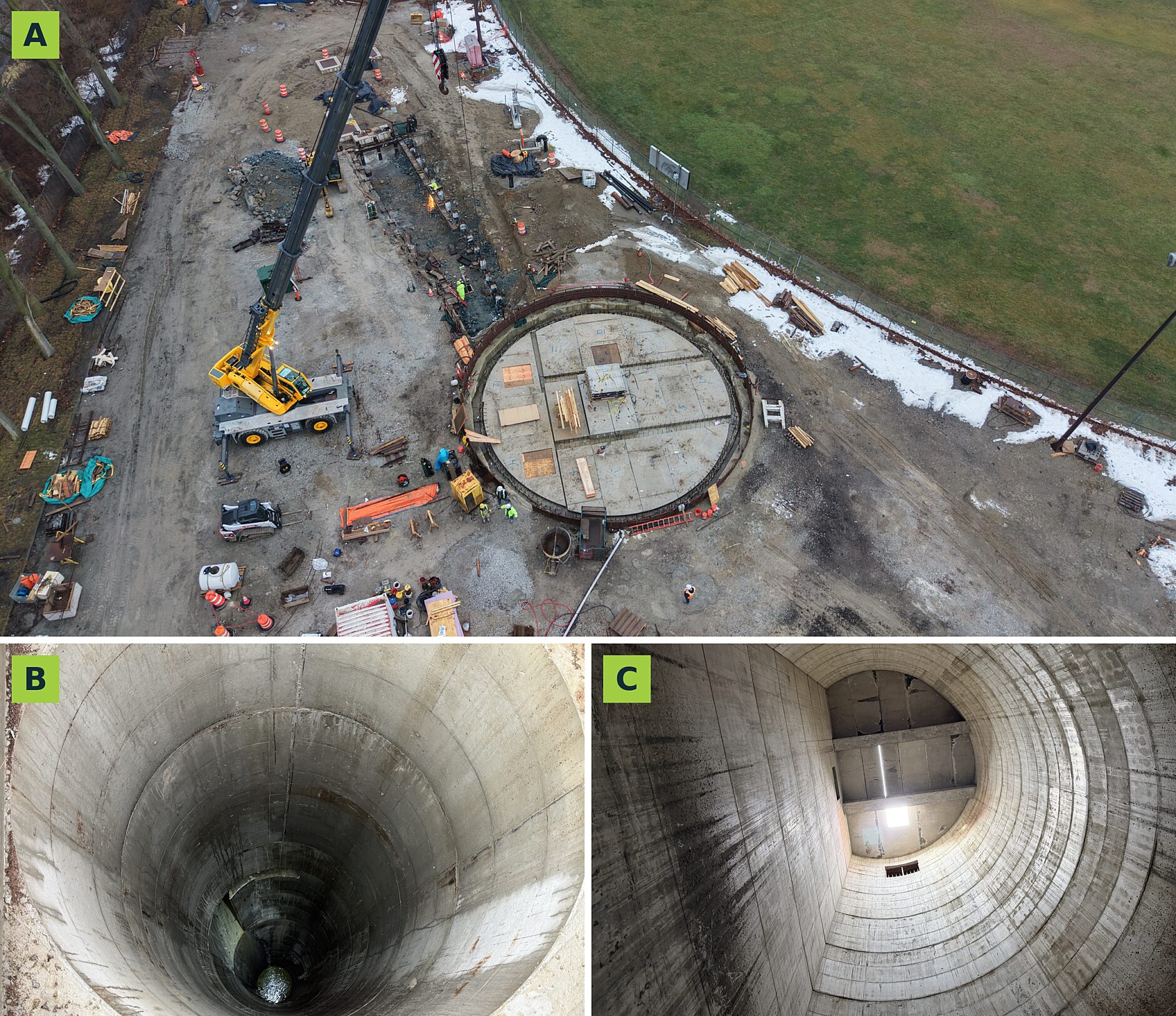
(A) Precast roof plank installation; (B) Looking down drop pipe encasement; (C) Post-construction inspection
SST-2 Shaft
This structure is a 50-foot (15.2 m) ID intermediate shaft approximately 132 feet (40.2 m) deep located about midway along the tunnel alignment. The permanent shaft structures included 1.5-foot (0.5 m) thick dividing wall, five baffle blocks, two precast beams, and a 113-foot-high (34.4 m) drop pipe encasement dropping flow about 84 feet (25.6 m) through a 6-foot-diameter (1.8 m) opening. These internal structures along with the precast roof planks and CIP roof slab were completed in February 2026. The SST-2 Shaft post-construction inspection was performed in March 2026.
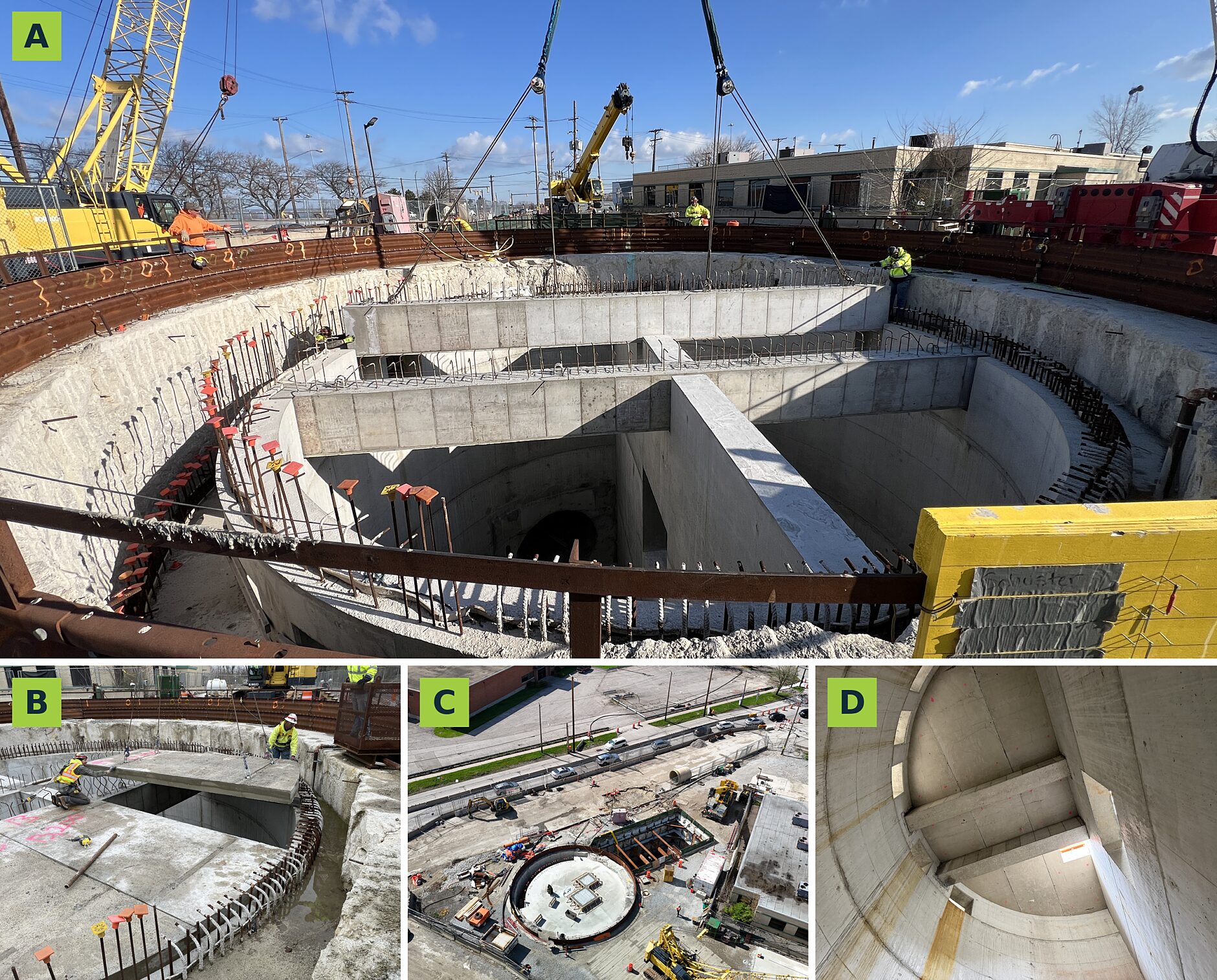
This structure is a 40-foot (12.2 m) ID retrieval shaft approximately 111 feet (33.8 m) deep. The shaft permanent structures included 2-foot thick dividing wall, six baffle slabs, and two precast beams. These structures along with the precast roof planks, removable roof planks, and CIP roof slab were completed in May 2025. The SST-3 Shaft post-construction inspection was performed in March 2026.
(A) Looking toward DST-4; (B) Jacking operation within SST-1 Shaft
Dewatering Tunnel
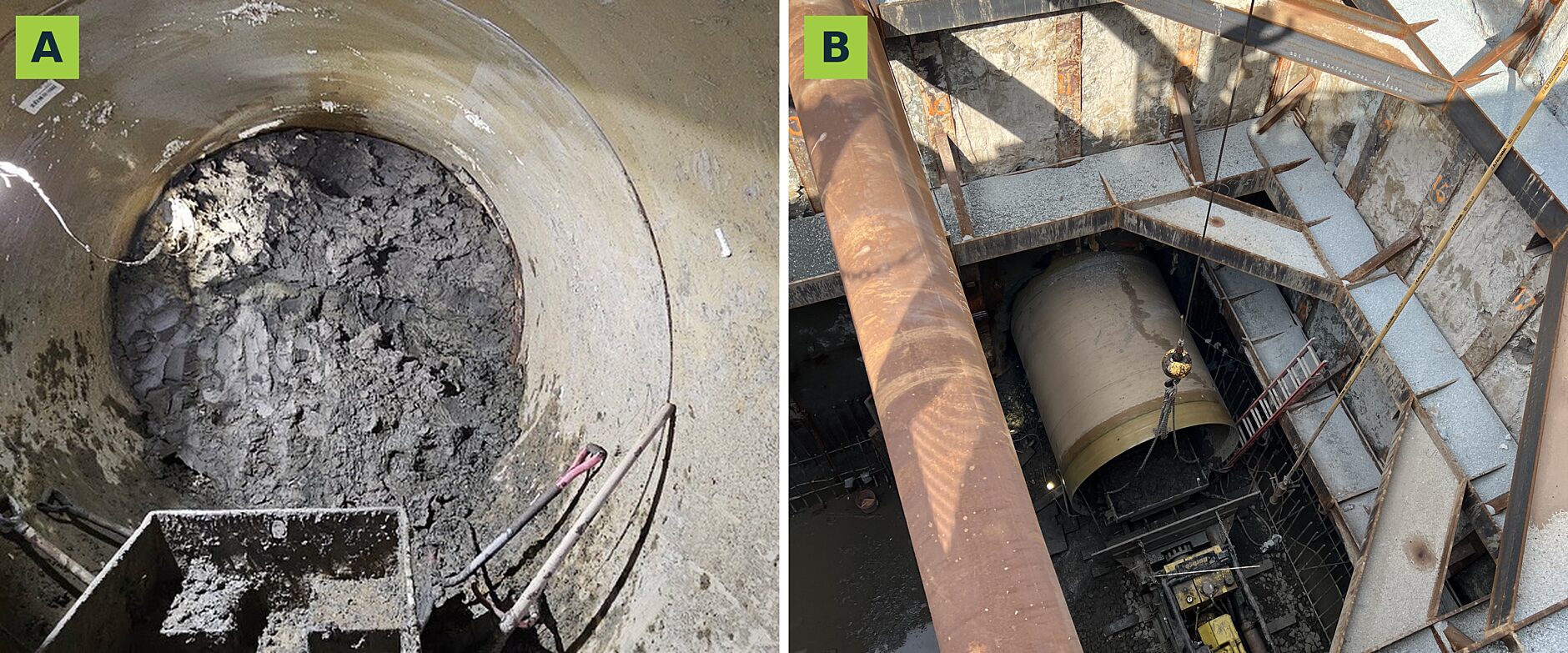
This tunnel was a hand-mined tunnel to convey CSO from the SST system into the Dugway Storage Tunnel (DST) system. This 72 foot-long (22 m) sewer was jacked from the SST-1 shaft to the DST-4 shaft. This sewer is about 112 feet (34.1 m) below grade and utilized a Barbco jacking system to install a 78-inch (198 cm) Hobas pipe. The dewatering tunnel was completed in February 2025. The post-construction inspection was performed in February 2025.
(A) Full face of clay; (B) Jacking operation within SST-3 GSS
SST-3 Consolidation Sewer
This tunnel was a hand-mined tunnel to convey CSO from an existing 120-inch (305 cm) brick sewer and the SST-3 Diversion Structure (SST-3 DS) to the SST-3 Gate and Screening Structure (SST-3 GSS). This 50 foot-long (15.2 m) sewer was jacked from the SST-3 GSS to the SST-3 DS. This sewer is about 35 feet (10.7 m) below grade and utilized a Barbco jacking system to install a 104-inch (264 cm) Hobas pipe. The consolidation sewer was completed in June 2025.
The project also featured additional near-surface structures and tunnels that have been completed. These include SST-2 Gate Control Vault (SST-2 GCV); SST-2 Diversion and Gate and Screening Structure (SST-2 DGSS); SST-2 84-inch (213 cm) Consolidation sewer; SST-2 Transition Chamber; SST-2 Tangential inlet and vortex drop structure; SST-3 GCV; SST-3 DS; SST-3 GSS; and Regulators E-33, E-34A, and E-43.
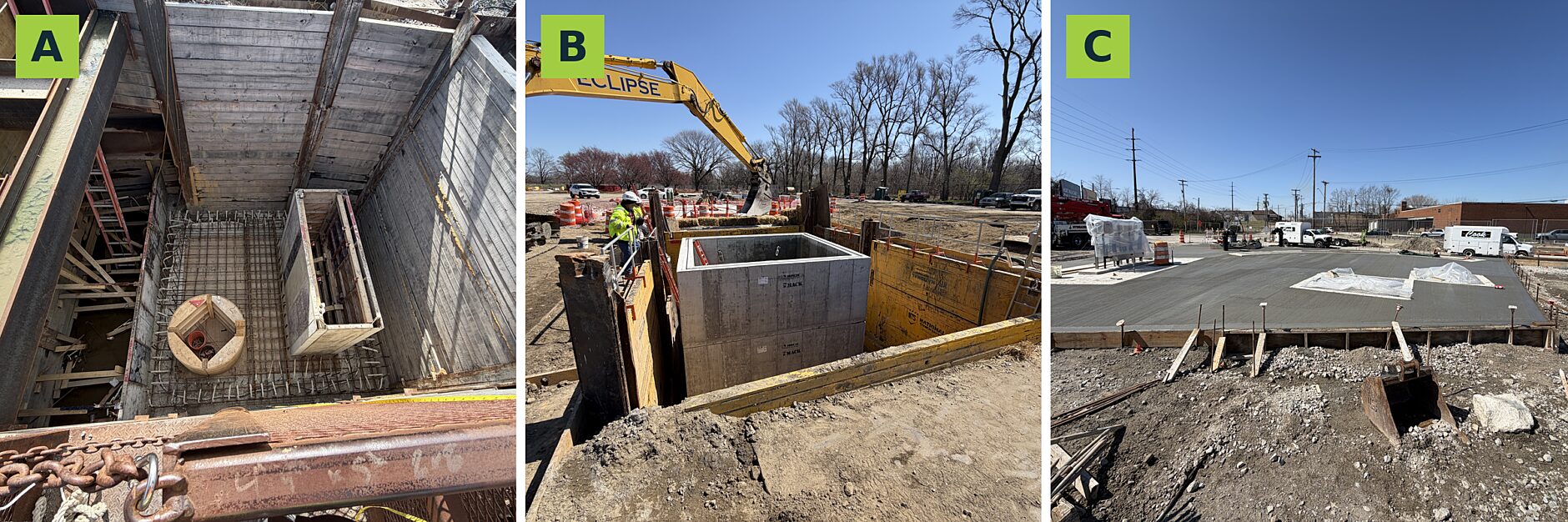
(A) SST-1 EOJC ongoing structure installation; (B) SST-2 Vent Vault (precast) currently being installed; (C) SST-3 Site Restoration –Concrete Pad over the SST-3 Shaft and GCV
Currently, construction is ongoing to complete three ventilation vaults at SST-1 and SST-2, Emergency Overflow Junction Chamber at SST-1 (SST-1 EOJC), electrical work related to the testing and commissioning of the gates and SST, and some site restoration. Upon the completion of commissioning, the SST will be ready to accept flow, allowing the Contractor to complete the remaining regulator modifications and final restoration for the project.